Showing posts with label history of cricket. Show all posts

History of Indian Cricket

>> Friday, January 15, 2010

Cricket is undoubtedly one of the most popular sports in India and the game is being played all over the country, since its inception. The exact day, month or year of Cricket`s inception in India is still shrouded in mystery, as nobody knows about it. However, according to some people, the Indians started playing the game for the first time in an organized way in the year 1848. The first Indian Cricket club named the Parsee Oriental Cricket Club was founded in that year and they played their first match in Bombay (Mumbai). Thus Cricket started its journey in India. Hence, the history of Indian Cricket can be identified as quite an old one.

However, according to some other, the history of Indian Cricket started its journey in the place named Sylhet (located in today`s Bangladesh). A clear evident has been found to prove this and it is a match report published in the Sporting Intelligence magazine, on 3rd March, 1845. The report was published by the editor of the Englishman newspaper and the news item was titled as "Sepoy Cricketers". The reporter actually gave a wonderful commentary of a match played between the European cricketers and the Sepoy cricketers. Apart from this news item, another report has been found to support the fact that Cricket was first played in Sylhet in India. This report was titled as "Sepoy Cricket at Sylhet" and in this report, the reporter wrote about the match between two regimental sides, each of which contained at least eight native cricketers. The reporter also termed the match to probably be the best contested encounter of that particular season. He also declared that "as usual the bowling of Sepoy Soophul was first rate...".

After its inception, Cricket started to get popularity among the Indian people within a short period of time. The middle and last half of the nineteenth century was an important period in the history of Indian Cricket, as the game spread its reach in almost all the parts of India during that period. Many teams from England started touring India by the close of the nineteenth century. There is a report published in the newspaper, `The Times of India` that supports this fact and the report was about the Presidency matches between the Parsees and the Lord Hawke`s Englishmen. The match was held in Bombay in 1892. The report described how the international Cricket matches that took place in Bombay at that time, increased interest among the local people. In the Metro cities of India like Calcutta (Kolkata), Bombay (Mumbai) and Madras (Chennai), Cricket was started to be played by the first half of the twentieth century. As the Hindus of India too started playing the game, the tournament of Bombay Presidency Matches became the Bombay Triangular in 1907-08. In 1912-13, the entry of the Muslims made it a quadrangular.
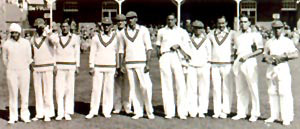
1932 First Test MatchThough India did not have a national cricket team during the early 1900s, a few Indian great cricketers of that era did represent the England cricket team. Ranjitsinhji and Duleepsinghji were the prominent ones among them. However, the first international exposure in the history of Indian Cricket came in the year 1926. In that year, a team from the Marylebone Cricket Club (MCC), led by A.E.R Gilligan toured India. Though it was an unofficial tour, the Indian people were quite interested and enthusiastic about the matches that MCC played during the tour. The legendary Indian cricket player, C. K. Nayudu played brilliantly during that tour and he also scored a century against the MCC side in Bombay. The tour was responsible to redefine the contours of Indian cricket. It ultimately spearheaded to the formation of the Board of Control for Cricket in India (BCCI) in the year 1928. India was accredited Test status by 1932, much before it got its Independence in 1947. India played against England in that year.

After Independence, a big push came in the history of Indian Cricket, when India got its first ever Test series win against the neighbouring Asian counterpart and archrivals Pakistan, in 1952. The series saw brilliant and extraordinary performances from some of the greatest Indian Cricket players like Polly Umrigar, Vijay Manjrekar and leg spinner SM Gupte. The Indian Cricket during 1960s saw the Indian team becoming a formidable side on home soil. It was also the decade, when the Indian team started playing well in overseas. India`s great performances on home soil were evident from the fact that India defeated New Zealand and held the teams like Pakistan, England and Australia to a draw, during that period. The 1960s also saw the rising of some of the greatly talented Indian Cricket players like Mansoor Ali Khan Pataudi, Dilip Sardesai, Hanumant Singh, Chandu Borde and not least of all, off-spinner EAS Prasanna.

The era of India`s spin quartet comprising Bishen Singh Bedi (left-arm spinner), Erapalli Prasanna (off-spinner), BS Chandrasekhar and Srinivas Venkataraghavan (off-spinner) during 1970s, is considered as the golden era in the history of Indian Cricket. Apart from the dominance of the spin quartet over all the batsmen of the world, 1970s also saw the rising of two of India`s greatest ever batsmen - Sunil Gavaskar and Gundappa Vishwanath. All of these great Indian Cricket players made their presence felt in the international circuit and contributed immensely in the success of Indian team. India successfully won consecutive Test series in West Indies and England in 1971 and the team was led by Ajit Wadekar, in both the series.
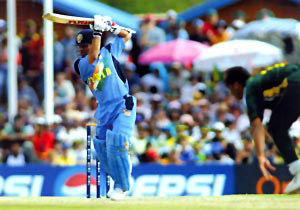
Sachin Tendulkar playing For World CupThe decade of 1980s in the history of Indian Cricket, saw the Indian team getting significant success in the shorter version of the game, One-Day Internationals (ODIs). India won the World Cup for the first time in 1983, and it was also the only time that India has so far become the world champions. The Indian Cricket saw the rising of some more great cricketers like Kapil Dev, Mahinder Amarnath, Madan Lal, etc, during the 1980s, as well. The entire decade of 1990s in the history of Indian Cricket was dominated by only one cricketer, named Sachin Tendulkar. Sachin is still continuing his service to the Indian Cricket and is considered to be one of the greatest cricketers in the History of Cricket. With the help of Sachin, and some other great cricketers like Sourav Ganguly, Rahul Dravid, Anil Kumble, Javagal Srinath, the Indian team successfully won several Cricket Trophies in and outside India.

The new millennium brought a new era in the history of Indian Cricket, as the Indian cricket team has shown some wonderful performances during this period. India has so far won the ODI trophies like Natwest, The Champions` Trophy, the Mini World Cup, etc. The team also beat the Cricketing superpowers like Australia, South Africa, England, West Indies, Pakistan, etc. in various Test series. In the new century, the Indian cricket has found a great captain in Sourav Ganguly, who took the team to the Final of the World Cup, 2003 and also led the team in getting some other great successes. The team is currently being led by the young and enthusiastic MS Dhoni in both the ODIs and in Tests. Dhoni led India in winning the ODI series in Australia distinctively, and he also led the team in noticeable performances in the recently concluded Kit Ply Cup in Bangladesh and in the Asia Cup. With Ganguly and Kumble already retired from the international cricket, and Tendulkar and Dravid approaching to the finishing stages of their illustrious careers, the future of Indian cricket now lies in the hands of the younger but experienced players. Some of the most notable Indian Cricket players of this time include Virender Sehwag, Harbhajan Singh, Mohammad Kaif and Yuvraj Singh along with the rookies like S Sreesanth, Munaf Patel, Suresh Raina, Irfan Pathan, Gautam Gambhir, Yousuf Pathan, Manoj Tiwari, Manpreet Goni, Rohit Sharma, Pragyan Ojha, Piyush Chawla, apart from the very much enthusiastic captain, Mahendra Singh Dhoni.

Read more...

Cricket"s World

The game of cricket

is really full of thrills, actions and passion. Every lover of cricket likes all these that makes him passionable about this game. This game brings the taste of enjoyment and satisfaction among its fans.

Here u will get a wide verity of articles , information ,videos latest updates history about the game .

HISTORY

The origins of cricket lie somewhere in the Dark Ages - probably after the Roman Empire, almost certainly before the Normans invaded England, and almost certainly somewhere in Northern Europe. All research concedes that the game derived from a very old, widespread and uncomplicated pastime by which one player served up an object, be it a small piece of wood or a ball, and another hit it with a suitably fashioned club.

How and when this club-ball game developed into one where the hitter defended a target against the thrower is simply not known. Nor is there any evidence as to when points were awarded dependent upon how far the hitter was able to despatch the missile; nor when helpers joined the two-player contest, thus beginning the evolution into a team game; nor when the defining concept of placing wickets at either end of the pitch was adopted.

Etymological scholarship has variously placed the game in the Celtic, Scandinavian, Anglo-Saxon, Dutch and Norman-French traditions; sociological historians have variously attributed its mediaeval development to high-born country landowners, emigré Flemish cloth-workers, shepherds on the close-cropped downland of south-east England and the close-knit communities of iron- and glass-workers deep in the Kentish Weald. Most of these theories have a solid academic basis, but none is backed with enough evidence to establish a watertight case. The research goes on.

What is agreed is that by Tudor times cricket had evolved far enough from club-ball to be recognisable as the game played today; that it was well established in many parts of Kent, Sussex and Surrey; that within a few years it had become a feature of leisure time at a significant number of schools; and - a sure sign of the wide acceptance of any game - that it had become popular enough among young men to earn the disapproval of local magistrates.


Dates in cricket history

1550 (approx) Evidence of cricket being played in Guildford, Surrey.

1598 Cricket mentioned in Florio's Italian-English dictionary.

1610 Reference to "cricketing" between Weald and Upland near Chevening, Kent. 1611 Randle Cotgrave's French-English dictionary translates the French word "crosse" as a cricket staff.
Two youths fined for playing cricket at Sidlesham, Sussex.

1624 Jasper Vinall becomes first man known to be killed playing cricket: hit by a bat while trying to catch the ball - at Horsted Green, Sussex.

1676 First reference to cricket being played abroad, by British residents in Aleppo, Syria.

1694 Two shillings and sixpence paid for a "wagger" (wager) about a cricket match at Lewes.

1697 First reference to "a great match" with 11 players a side for fifty guineas, in Sussex.

1700 Cricket match announced on Clapham Common.

1709 First recorded inter-county match: Kent v Surrey.

1710 First reference to cricket at Cambridge University.

1727 Articles of Agreement written governing the conduct of matches between the teams of the Duke of Richmond and Mr Brodrick of Peperharow, Surrey.

1729 Date of earliest surviving bat, belonging to John Chitty, now in the pavilion at The Oval.

1730 First recorded match at the Artillery Ground, off City Road, central London, still the cricketing home of the Honourable Artillery Company.

1744 Kent beat All England by one wicket at the Artillery Ground.
First known version of the Laws of Cricket, issued by the London Club, formalising the pitch as 22 yards long.

1767 (approx) Foundation of the Hambledon Club in Hampshire, the leading club in England for the next 30 years.

1769 First recorded century, by John Minshull for Duke of Dorset's XI v Wrotham.

1771 Width of bat limited to 4 1/4 inches, where it has remained ever since.

1774 LBW law devised.

1776 Earliest known scorecards, at the Vine Club, Sevenoaks, Kent.

1780 The first six-seamed cricket ball, manufactured by Dukes of Penshurst, Kent.

1787 First match at Thomas Lord's first ground, Dorset Square, Marylebone - White Conduit Club v Middlesex.
Formation of Marylebone Cricket Club by members of the White Conduit Club.

1788 First revision of the Laws of Cricket by MCC.

1794 First recorded inter-schools match: Charterhouse v Westminster.

1795 First recorded case of a dismissal "leg before wicket".

1806 First Gentlemen v Players match at Lord's.

1807 First mention of "straight-armed" (i.e. round-arm) bowling: by John Willes of Kent.

1809 Thomas Lord's second ground opened at North Bank, St John's Wood.

1811 First recorded women's county match: Surrey v Hampshire at Ball's Pond, London.

1814 Lord's third ground opened on its present site, also in St John's Wood.

1827 First Oxford v Cambridge match, at Lord's. A draw.

1828 MCC authorise the bowler to raise his hand level with the elbow.

1833 John Nyren publishes his classic Young Cricketer's Tutor and The Cricketers of My Time.

1836 First North v South match, for many years regarded as the principal fixture of the season.

1836 (approx) Batting pads invented.

1841 General Lord Hill, commander-in-chief of the British Army, orders that a cricket ground be made an adjunct of every military barracks.

1844 First official international match: Canada v United States.

1845 First match played at The Oval.

1846 The All-England XI, organised by William Clarke, begins playing matches, often against odds, throughout the country.

1849 First Yorkshire v Lancashire match.

1850 Wicket-keeping gloves first used.

1850 John Wisden bowls all ten batsmen in an innings for North v South.

1853 First mention of a champion county: Nottinghamshire.

1858 First recorded instance of a hat being awarded to a bowler taking three wickets with

consecutive balls.

1859 First touring team to leave England, captained by George Parr, draws enthusiastic crowds in the US and Canada.

1864 Overhand bowling authorised by MCC.
John Wisden's The Cricketer's Almanack first published.
1868 Team of Australian aborigines tour England.

1873 WG Grace becomes the first player to record 1,000 runs and 100 wickets in a season.
First regulations restricting county qualifications, often regarded as the official start of the County Championship.

1877 First Test match: Australia beat England by 45 runs in Melbourne.

1880 First Test in England: a five-wicket win against Australia at The Oval.

1882 Following England's first defeat by Australia in England, an "obituary notice" to English cricket in the Sporting Times leads to the tradition of The Ashes.

1889 South Africa's first Test match.
Declarations first authorised, but only on the third day, or in a one-day match.

1890 County Championship officially constituted.
Present Lord's pavilion opened.

1895 WG Grace scores 1,000 runs in May, and reaches his 100th hundred.

1899 AEJ Collins scores 628 not out in a junior house match at Clifton College, the highest individual score in any match.
Selectors choose England team for home Tests, instead of host club issuing invitations.
1900 Six-ball over becomes the norm, instead of five.

1909 Imperial Cricket Conference (ICC - now the International Cricket Council) set up, with England, Australia and South Africa the original members.

1910 Six runs given for any hit over the boundary, instead of only for a hit out of the ground.

1912 First and only triangular Test series played in England, involving England, Australia and South Africa.

1915 WG Grace dies, aged 67.

1926 Victoria score 1,107 v New South Wales at Melbourne, the record total for a first-class innings.

1928 West Indies' first Test match.
AP "Tich" Freeman of Kent and England becomes the only player to take more than 300 first-class wickets in a season: 304.

1930 New Zealand's first Test match.
Donald Bradman's first tour of England: he scores 974 runs in the five Ashes Tests, still a record for any Test series.

1931 Stumps made higher (28 inches not 27) and wider (nine inches not eight - this was optional until 1947).

1932 India's first Test match.
Hedley Verity of Yorkshire takes ten wickets for ten runs v Nottinghamshire, the best innings analysis in first-class cricket.

1932-33 The Bodyline tour of Australia in which England bowl at batsmen's bodies with a packed leg-side field to neutralise Bradman's scoring.

1934 Jack Hobbs retires, with 197 centuries and 61,237 runs, both records. First women's Test: Australia v England at Brisbane.

1935 MCC condemn and outlaw Bodyline.

1947 Denis Compton of Middlesex and England scores a record 3,816 runs in an English season.

1948 First five-day Tests in England.
Bradman concludes Test career with a second-ball duck at The Oval and a batting average of 99.94 - four runs short of 100.

1952 Pakistan's first Test match.

1953 England regain the Ashes after a 19-year gap, the longest ever.

1956 Jim Laker of England takes 19 wickets for 90 v Australia at Manchester, the best match analysis in first-class cricket.

1957 Declarations authorised at any time.

1960 First tied Test, Australia v West Indies at Brisbane.

1963 Distinction between amateur and professional cricketers abolished in English cricket.
The first major one-day tournament begins in England: the Gillette Cup.

1969 Limited-over Sunday league inaugurated for first-class counties.

1970 Proposed South African tour of England cancelled: South Africa excluded from international cricket because of their government's apartheid policies.

1971 First one-day international: Australia v England at Melbourne.

1975 First World Cup: West Indies beat Australia in final at Lord's.

1976 First women's match at Lord's, England v Australia.

1977 Centenary Test at Melbourne, with identical result to the first match: Australia beat England by 45 runs.
Australian media tycoon Kerry Packer, signs 51 of the world's leading players in defiance of the cricketing authorities.

1978 Graham Yallop of Australia wears a protective helmet to bat in a Test match, the first player to do so.

1979 Packer and official cricket agree peace deal.

1980 Eight-ball over abolished in Australia, making the six-ball over universal.

1981 England beat Australia in Leeds Test, after following on with bookmakers offering odds of 500 to 1 against them winning.

1982 Sri Lanka's first Test match.

1991 South Africa return, with a one-day international in India.

1992 Zimbabwe's first Test match.
Durham become the first county since Glamorgan in 1921 to attain firstclass status.

1993 The ICC ceases to be administered by MCC, becoming an independent organisation with its own chief executive.

1994 Brian Lara of Warwickshire becomes the only player to pass 500 in a firstclass innings: 501 not out v Durham.

2000 South Africa's captain Hansie Cronje banned from cricket for life after admitting receiving bribes from bookmakers in match-fixing scandal.
Bangladesh's first Test match.
County Championship split into two divisions, with promotion and relegation.
The Laws of Cricket revised and rewritten.

2001 Sir Donald Bradman dies, aged 92.

2003 Twenty20 Cup, a 20-over-per-side evening tournament, inaugurated in England.

2004 Lara becomes the first man to score 400 in a Test innings, against England.

2005 The ICC introduces Powerplays and Supersubs in ODIs, and hosts the inaugural Superseries.

2006 Pakistan forfeit a Test at The Oval after being accused of ball tampering.

(RESOURCES OF INFORAMTION FROM ENCYCLOPEDIA AND GOOGLE)

Read more...

BITTY BROWSER

About This Blog

Blog Archive

  © Blogger template Webnolia by Ourblogtemplates.com 2009

Back to TOP